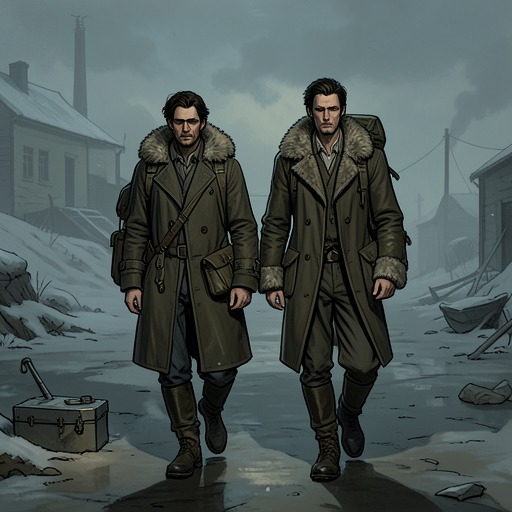
Michael Holloway
Washington BlackMichael Holloway, also called Captain Holloway, commands the Calliope during Washington Black and Titch’s passage from the American coast toward the far north. He is not a slave trader, but his treatment of Washington reveals how racial prejudice persists in spaces that are not themselves organized around enslavement. His ship offers passage, not equality or safety; the journey eventually brings the travellers to an Arctic trading post while exposing the commercial purpose of the expedition.
Identity and Introduction
Holloway is a short, stocky captain who was born and raised in Chattanooga. He has little good to say about his birthplace, does not drink, and keeps a steaming glass of tea close at hand. His ship, the Calliope, is smaller than the Ave Maria but newer in its fixtures. These details establish him as a disciplined, practical seaman rather than a figure of the openly slave-trading world Washington has escaped.
That distinction does not make Holloway free of prejudice. Washington describes him as maintaining a strong division between Black and white people. His second, Jacob Ibel, shares a close friendship with the captain dating back to boyhood, yet is less prejudiced. Their contrast makes clear that the captain’s assumptions are personal as well as part of the broader racial order surrounding the voyage.
Command of the Calliope
Before boarding, Titch and Washington acquire clothing, provisions, and equipment with money supplied by Edgar Farrow. They sail at dawn in a strong wind. Holloway commands the passage north, while Ibel acts as his second. Washington distrusts both men, even though Ibel speaks to him as a human being and invites him to play cards.
At first, Holloway will merely tolerate Washington’s presence at meals; Washington is not invited to speak, and the captain remains unsettled by his burns. By the time the ship is off Labrador, the captain has softened somewhat, but the limits of that change remain evident. Washington wears all three of his shirts and a thick coat even while sleeping as the ship enters colder waters, while the adults discuss the expedition around him. His presence on board does not translate into equal standing.
The Expedition and Its Purpose
During a luncheon in the captain’s quarters, Titch asks whether it is early in the season to be sailing north. Holloway confirms that it is, explaining that the party hopes to be first in those waters. When Titch asks about the safety of the ice, Holloway answers that rewards entail risks. The remark initially leaves the expedition’s purpose unstated, but Ibel soon explains that they are seeking the wreck of a whaler, the Magnolia Lion, which was crushed in the ice off Baffin Island two Novembers earlier.
The wreck is valuable because its crew had unloaded barrels of oil before the ship went down and buried them under a shelter on a nearby island. Ibel relates that he learned of the wreck and the oil from Mister MacBane, an old seaman and friend of his father who had survived being trapped in the snow and had suffered severe frostbite. Titch recognizes that the recovery could be profitable, and Holloway confirms that profit is the undertaking’s aim. Holloway’s command therefore carries the party north not simply as a voyage of passage, but as a commercial expedition into dangerous waters.
Washington and the Limits of Tolerance
Holloway’s conduct aboard the Calliope sits within a wider pattern in Washington’s life: movement across borders changes the legal circumstances of freedom without removing the threat of racial control. Before this passage, Titch explains that entering Chesapeake Bay will bring them under American laws of freedom, while warning that freedom means different things to different people. Washington’s experience makes the warning concrete. Even when a captain is not a slaver, Washington must gauge whether he may be treated as a person, whether he can speak, and whether his appearance will mark him as unwelcome.
The difference between Holloway and Ibel is significant but limited. Ibel’s respectful conversation offers Washington a more humane interaction at sea; it does not undo Holloway’s racial distinctions or erase Washington’s dependence on the ship’s officers. The Calliope thus becomes a temporary passage through an unequal world, not a refuge from it.
Departure and Narrative Significance
When the travellers finally near the bay and the trading post, the waters are calm and speckled with ice. Titch shakes hands with Holloway and Ibel, and he and Washington climb into a small cutter to be rowed to the post’s leaning wooden shacks. Holloway’s role ends with the shipboard leg of the journey: he has brought them north, but the evidence does not show him accompanying them ashore or taking part in what follows there.
Holloway’s brief but consequential place in the narrative complicates the idea that escape alone brings freedom. He is not identified as a slaver, and the voyage carries Washington away from the immediate danger of capture; nevertheless, the captain’s assumptions continue to define the terms on which Washington is permitted aboard. His character helps distinguish physical passage from social emancipation, while the whaling expedition’s profit motive links the voyage to the hazards and commerce of the northern waters.